Early baptismal records of New Minden, Illinois, USA
New Minden’s only church is St John’s Lutheran, founded in 1846 by German settlers. In 1847 the church became one of the charter members of the The Missouri Synod. Transcribed records from the congregation (translated from the original German) were loaded into Ancestry in 2023.
I chose to focus on the year 1864, when New Minden was experiencing a “baby boom.” During this year, the church recorded 61 infant baptisms. This is compared to just 19 baptisms in 1854 and 25 baptisms in 1859.
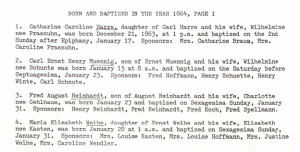
Of the first four infants shown in the excerpt below, the third (Fred August Reinhardt) lived only 2 months, but the other three children survived to adulthood. (The fourth child, Maria Elisabeth Weihe, is my 2nd great-grandmother.) The mothers and fathers of these babies were born in Germany. The families were linguistically, culturally, and ethnically German.
From Ancestry.com record set Missouri Synod, U.S., Lutheran Church records, Saint John Lutheran Church, New Minden, IL, 1846-1899 (Translated Church records).
Examining the baptism records from 1864 yields the following insights:
Infants had two or three given names (e.g., Carl Ernst Henry), but by the time they reached confirmation age (13 or 14 years old), most children were using just one of their given names. For example: Catharine Caroline Harre was confirmed as Karoline in 1878, Carl Ernst Henry was confirmed as Carl in 1877, and Maria Elisabeth was confirmed as Maria in 1877.
Baptismal records almost always included the maiden name of the mother. This is extremely helpful for genealogical research.
Baptismal records included a birth date and often a time of birth as well.
The date of baptism included the date in the Liturgical calendar (e.g., Sexagesima Sunday).
Infants were usually baptized on a Sunday between 1 and 2 weeks after birth. However, emergency baptisms could be performed on any day. For example, the record for Caroline Wilhelmine Hesemann states that she was born June 25, 1864, and baptized 4 days later at home because she was ill.
Infants had between two and four baptism sponsors (godparents). Girls had only female sponsors, whereas boys had male sponsors. Over time, this tradition changed. At my Lutheran baptism in 1977 I had one male and one female godparent.
Illegitimate children are conspicuously absent from these baptism records, at least for the year 1864. Each set of parents is married. I will have to do some more digging to see what happened to illegitimate children in New Minden. Were unwed mothers cast out of the congregation?
How do these baptisms in New Minden compare to the baptisms in your place?
We use cookies to ensure that we give you the best experience on our website. If you continue to use this site we will assume that you are happy with it.