
The Society for One-Place Studies is a leading organisation dedicated to supporting One-Placers worldwide.




Introduction
The Blackpool Improvement Act, 1879 included a clause which read:
“The Corporation may from time to time pay or contribute towards the payment of a public band of music for the borough, and also the cost of maintaining at railway stations and other public places advertisements stating the attractions and amusements of the town; provided that the amounts of such payments or contributions do not in any year exceed the rate of twopence in the pound on the rateable value of the borough”.
The power to advertise the town as a resort on the rates was a significant factor in the development of Blackpool as a tourist resort during the late nineteenth and early twentieth centuries. The inclusion of such a clause within legislation was unusual and enabled Blackpool to spend more than other resorts on advertising the town until well into the twentieth century, to the dismay of competitor resorts, with the Yorkshire Herald, with reference to Scarborough, bemoaning that “Blackpool [is] advertising its attractions, by enormous placards, even in our Queen of Watering-places here”. Rival seaside resorts were generally denied powers to spend the rates on advertising themselves until the passing of the Health Resorts and Watering Places Act 1921, which permitted local authorities to use trading profits up to an equivalent of a penny on the pound to advertise their towns, still significantly lower than Blackpool’s upper limit.
The Corporation established an Advertising Committee to oversee the Corporation’s advertising of the town. John K Walton, who has written prolifically on English seaside resorts and particularly on Blackpool, says that the Advertising Committee had two primary objectives – widening Blackpool’s catchment area i.e. the geographic area where visitors to Blackpool lived, and extending the resort’s season
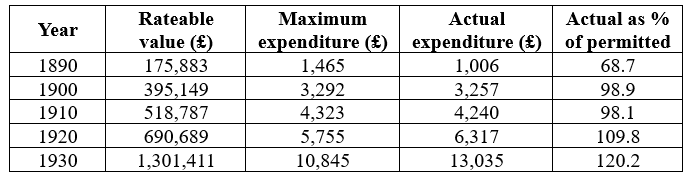
The annual expenditure authorised by the Advertising Committee naturally increased over time along with the town’s rateable value, as shown in the table below. On. occasion it would seem that the authorised expenditure exceeded the maximum permitted. In 1901 Thomas Loftos, Blackpool’s Town Clerk admitted that “a resort to the rates is open to abuse, and there is [in Blackpool] a temptation from time to time to give a very elastic and too free an interpretation” of permitted expenditure.
The poster campaign
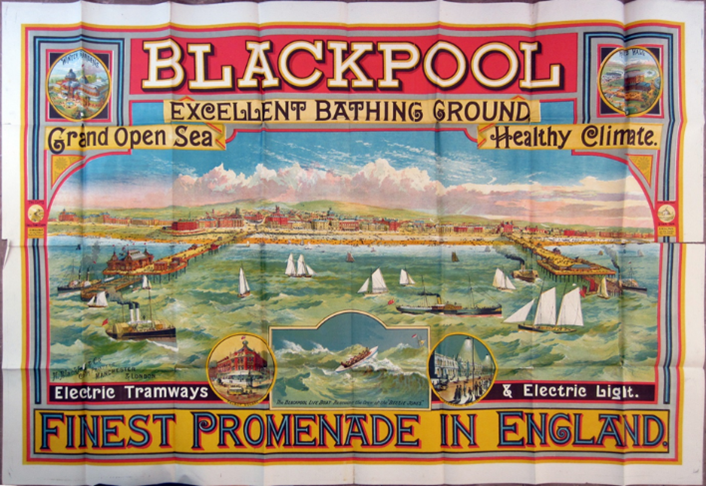
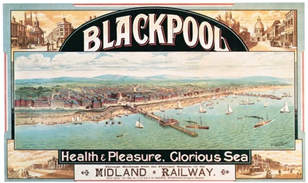
Posters formed a significant part of the Advertising Committee’s approach. It is not always obvious to what extent posters originated with the Corporation, with the railway companies (important stakeholders for the Corporation) or were a joint venture. However the posters shown here originated with the Corporation and the Midland Railway respectively.
In the final decade of the nineteenth century posters were generally sited in northern and central England, as well as in Ireland and on the Isle of Man. In the first two decades of the twentieth century, advertising locations extended to include Scotland, Wales, London and the south east and even Europe and the United States. An increased focus on visitors from London can be seen in the Corporation maintaining an information office in London from 1903 and making payments in 1905 to advertise in newspapers such as the Croydon Guardian, the Middlesex & Buckinghamshire Advertiser, the Surrey Advertiser and the Kentish Mercury.
The Official Guide to Blackpool
The Advertising Committee also instituted the publication of brochures to advertise the town. Official Guides to Blackpool were published annually by the Corporation from 1897 for the main season and from 1912 for the autumn season.
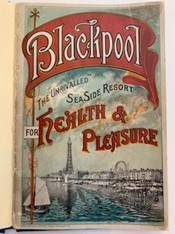
50,000 copies of the 1897 guide were printed at a cost of just over £196. Only three years later 120,000 copies were produced at a cost of approximately £525. It is interesting to note how the balance of content in the guides changed over time. In the first edition, adverts accounted for 18 of 64 pages (28.1%) but by 1914 adverts accounted for 47 of 80 pages (58.8%), which would have considerably reduced the net cost of producing the guides.
Sponsorship of events
A third strand of the Advertising Committee’s efforts to attract increased numbers of visitors to Blackpool was the sponsorship of events. This was often linked to attempts to extend the season into the Spring/early Summer and Autumn months (and subsequently at Christmas) including:
Of course the Advertising Committee was also supportive of the Corporation’s adoption of the Illuminations in the Autumn months.
The Society for One-Place Studies is a leading organisation dedicated to supporting One-Placers worldwide.