
The Society for One-Place Studies is a leading organisation dedicated to supporting One-Placers worldwide.




From 1851 onwards the national United Kingdom census was usually taken at the end of March or early April. However, in 1921 the census was put back from 14 April and taken on the night of 19 June, due to serious levels of industrial unrest earlier in the year.
The later date meant that the census was taken during the summer holiday season. The Registrar-General recognised that the raw numbers would be affected by the number of holiday-makers in resorts and would need to be adjusted to address the issue.
Writing in Numbering the holidaymakers: the problems and possibilities of the June census of 1921 for historians of resorts published in The Local Historian in November 1993, John K Walton and Cliff O’Neill wrote that Blackpool, a seaside resort in Lancashire, England, had 25,807 visitors recorded on 19 June 1921, the highest number in absolute terms, although the town ranked only 25th in terms of the number of visitors as a percentage of the estimated resident population.
The Registrar-General’s staff went through the census schedules with, according to Walton and O’Neill, the objective of ‘reallocating holiday-makers to their usual place of abode, or at least removing them from the resort populations and transferring them elsewhere’. As a result, Blackpool’s population was reduced from 99,640 to 73,800.
An example of the checks and adjustments made to census returns can be seen in the return for 7 Lunas Square in Blackpool, where the Head of the Household was Elizabeth Martindale, a Company House Keeper who was born in Wigan, Lancashire, some 40 miles from Blackpool.
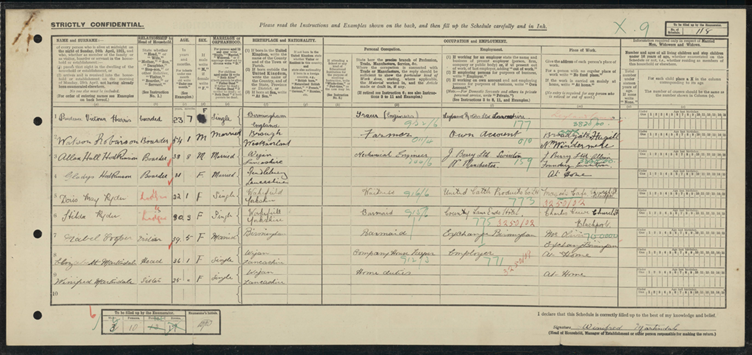
Population size and growth were regarded as measures of a town’s health and prestige. Such a massive reduction in Blackpool’s population figure did not go down well with the local press or civic leaders.
Walton and O’Neill write that whilst the Blackpool Gazette accepted that the raw figure included a substantial number of holiday-makers, the newspaper rejected the suggestion that the number of seaside visitors could explain the population falls recorded in a number of large Lancashire industrial towns, saying in an editorial on 25 August 1921:
‘It has to be remembered that on June 19th the Lancashire ‘wakes’ season had not commenced; that we were still in the grip of the coal dispute; that trade in Lancashire was unsettled, and the future prospect not too bright; and that not only were there no excursions, but travelling facilities were considerably curtailed’.
Councillor David Dickinson, Blackpool’s Mayor at the time, got involved, with Walton and O’Neill writing that in the Mayor’s opinion ‘the maximum conceivable number of visitors was only 10,000’. On 31 March 1922 the Blackpool Gazette reported the Mayor’s remarks at a civic lunch, that the reduction in the town’s population figure was due to some ‘terrible mistake’ and that ‘Government officials occasionally made mistakes’. The Mayor’s remarks were apparently greeted with much laughter from those present at the lunch.
Data from the Vision of Britain website shows that the population of some Lancashire towns did reduce between 1911 and 1921, possibly also suggesting that the population figures for those towns were not adjusted upwards to reflect the holiday-maker effect.
| Town | 1911 population | 1921 population | Reduction |
|---|---|---|---|
| Accrington | 45,029 | 43,595 | 1,434 |
| Blackburn | 181,725 | 172,626 | 9,099 |
| Bolton | 265,084 | 262,044 | 3,040 |
| Burnley | 131,163 | 126,145 | 5,018 |
| Bury | 129,637 | 128,313 | 1,324 |
It is possible that the Registrar-General did overstate the number of visitors in Blackpool on the night of the 1921 census. However, it is interesting to note that the seasonal increase in Blackpool’s population was not solely due to the number of holiday-makers. As Walton and O’Neill note, Blackpool’s population in June was ‘already being swollen by seasonal migrant workers and by the large number of boarding-house keepers and others who were resident for only part of the year. The way in which the discussion focused solely on visitors and permanent residents was deeply misleading’.
The Society for One-Place Studies is a leading organisation dedicated to supporting One-Placers worldwide.