
The Society for One-Place Studies is a leading organisation dedicated to supporting One-Placers worldwide.




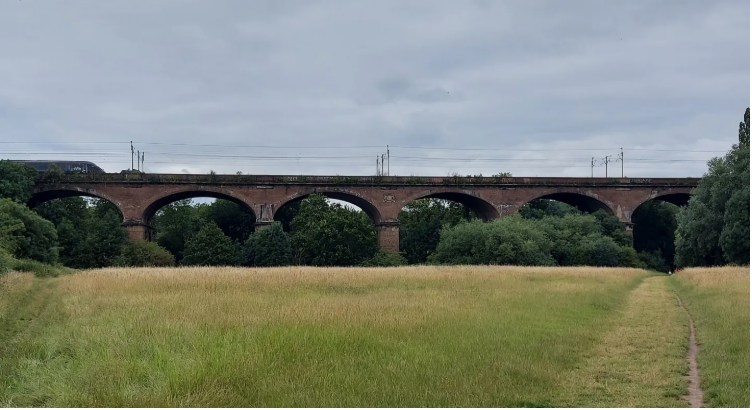
Could you imagine Hanwell without its viaduct? The whole feeling of the place would be transformed. The Wharncliffe Viaduct is one of the most recognisable landmarks in the area and features on a lot of local imagery, including St Mark’s school logo. And there’s a lot more about it than meets the eye.
The viaduct was built in 1836–37 to carry the Great Western Railway – at the time a new transport link between London and all points west – over the River Brent and its wide shallow valley. It was the most challenging feat of engineering on the first section of the railway, between London and the River Thames at Maidenhead.
This architectural beauty consists of a series of arches formed by hollow piers made of engineering brick. It was the first viaduct to be built this way. It was also the first major project designed by Isambard Kingdom Brunel, so he must have been pretty confident the hollow pier structure would work (as well as save a fortune in bricks). All the same, thousands of bricks were needed so a brickyard was set up nearby, along with carpentry workshops, presumably for all the wooden scaffolding that needed to be assembled.
It’s huge, stated to be 20 metres high, but it seems a lot more than that. When you’re standing underneath it, it’s overwhelming. Originally it carried only two railway tracks, and was so narrow those crossing it might have had to close their eyes to avoid suffering the indignity of vertigo. In 1877 the builders added an extra row of piers and arches, increasing the width of the viaduct so it could carry four narrow gauge railway tracks instead of two broad ones.
Queen Victoria must have had a pretty good head for heights. She is said on occasion to have commanded the Royal Train to stop awhile on the viaduct to enjoy the splendid view over meadow, field and woods. I can see why – the mid-air crossing does feel all too brief. Her Majesty was perhaps also thrilled by a sensation akin to that of being in one of the Montgolfier brothers’ balloons. This bridge over land soon became a tourist attraction and a nearby coaching inn on the Uxbridge Road, then a major turnpike, changed its name from the Coach & Horses to The Viaduct.
Brunel’s spectacular construction is 270 metres long. It goes in a straight line; no deviations, neither up nor down, nor side-to-side – only forward and back, forward and back.
In addition to tonne upon tonne of steel rail for the trains, the viaduct has always carried an assortment of other items of infrastructure for power or communications. From the outset Brunel was keen to use the new-fangled electric telegraph system to help run the railway, which soon expanded into commercial use. In 1845, the new telegraph system was used to catch John Tawell, a murder suspect travelling to Paddington. It was probably the first time a telegraph message was used for this purpose. It was quite long:
“A murder has just been committed at Salt Hill and the suspected murderer was seen to take a first class ticket to London by the train that left Slough at 7.42pm. He is in the garb of a Kwaker with a brown great coat on which reaches his feet. He is in the last compartment of the second first-class carriage.”
Ever since, telegraph poles and wires, transatlantic trunk route cabling, overhead power lines to keep the trains moving, and more recently untold uncoils of fibre-optic cabling have been heaped upon the uncomplaining edifice. All that metal, carrying all that electricity. The crackle and hum of an electromagnetic field, whose swirls of energy can bend space, time and mind. An electric line to your zodiac sign, as Hawkwind once put it. I bet it looked far out amazing to the locals back in the day, as it took shape, with its sheer size and the graceful curves of its arches. Perhaps some doffed their hats to the coat of arms of Lord Wharncliffe that has pride of place at the top of the central pier overlooking Brent Meadow. This man was head of the committee that got the Bill through Parliament enabling the viaduct to be built.
There’s no such memorial to the navigators or navvies, most of them Irish, who did the actual building with nothing more than picks, shovels and gunpowder. According to Andrew Roden, in Great Western Railway – a History, they usually lived in camps near where they were working, often in appalling conditions. There were many, often fatal, accidents because of pressure from contractors and the high instance of working while drunk.
No memorial to them, maybe, but their memory lives on through historical records, such as this excerpt from Some accounts of bygone Hanwell written by Sir Montagu Sharpe in 1924:
“In 1836, a large body of Irish men engaged in constructing the Great Western Railway went to The Stag beerhouse, where a few Englishmen had assembled, and a row commenced … Three prisoners were sentenced to two months in the House of Correction by the magistrates, who sent a letter to the Company, and stated that unless something was done, it would be necessary to apply to the Government for a body of police or military, to be stationed at Hanwell.”
When I look up at the viaduct I sometimes picture the navvies hauling bricks up wobbly wooden scaffolding and hum snatches from the song Towers of London by XTC:
Fog is the sweat of the never-never navvies who pound, pound, pound, pound, pound
Spikes in the rails to their very own heaven
Rain is the tears of the never-never navvies who cry
For the bridge that doesn’t go in the direction of Dublin
From Hanwell station the viaduct starts off as a steep embankment, broken by Hanwell Small Viaduct, with three mini arches that cross Station Road, and a further three filled in to form business units. Even under these smaller arches you wonder that the bricks don’t fall, given the wide bands of mortar between them.
Take a walk on the north side in summer, along the path that runs at the bottom of Churchfields, and the thick stands of tall leafy trees almost totally obscure the viaduct in places. So much so that when a train crosses over it seems to be flying through the treetops. And they do cross frequently, the viaduct seeming to reverberate and amplify the deep whistle whoosh of the express, the busy clatter of freight trains and the steady rumble of the local stopping service.
By the time you get to Brent Lodge Park, the viaduct is no longer visible at all through the dense woodland. The shrieks and yelps behind me add to the jungle effect, though I’m not sure whether they emanate from nearby Hanwell Zoo or perhaps some small children lost in the adjacent maze.
From the other side, the viaduct dominates the skyline above Brent Meadow. In the top left corner you can cut in under the viaduct. The first thing you notice is how chilly it is and how cool to the touch the bricks are. Water drips continually from the underside of the arches, as if a microclimate were at play. The immense hollow cavities inside the supporting piers are home to several colonies of bats, most likely Daubenton’s bat. This is probably the largest bat cave complex in the London area. Only licensed bat-workers may enter, through entrance grilles that look like the gates to a Gothic prison tower. Green metal fencing serves to discourage intruders. Here, at the western end you can get closer to the grilles than at the other end. It feels scarier here – I thought I heard noises that weren’t water dripping. Round a pier and under again, to be greeted by cool graffiti; a haunt where people meet, then leave, and leave their rubbish behind.
In this corner of Brent Meadow there’s also a small allotment under the shelter of the viaduct looming behind, which at this point is shared with Southall. A scarecrow watches an old couple harvesting new potatoes. A little further on an embankment rises to meet the viaduct as it ends its run behind a row of houses in Brentvale Avenue. Some garden feature that must be.
These houses probably weren’t very old when the German Luftwaffe tried to destroy the viaduct during the Second World War. They considered it an important strategic target, but all the bombs they dropped either missed their target or failed to explode.
There’s faded graffiti high up on the top wall. One ancient piece in particular stands out: JRNBLADE. Neatly done in a kind of copperplate style with interlocking characters and decent kerning. Old school rather than old skool. I guess the brave artist who created it was balancing 60 feet or so up in the air, perhaps in the middle of the night. I recently discovered that it dates back to 1984. MOURNBLADE was a Hawkwind-inspired local heavy metal band. Their JRNBLADE graffiti deserves to be restored and listed. And if they’re still going, it’d be great to see them play at the Hanwell Hootie, underneath the Wharncliffe wonder in Brent Meadow.
This article is re-used with permission of the author, Tony Sears (https://wp.me/pcFwL2-57)
The Society for One-Place Studies is a leading organisation dedicated to supporting One-Placers worldwide.