Country: England

Region (County/State/Province): North Yorkshire

Website: www.rillingtonhistory.com

Contact: Pam Smith

Photo Credit: Member’s own photograph

Study Description 

Rillington is an historic rural parish in North Yorkshire, situated approximately five miles north-east of Malton and today divided by the A64 (York–Scarborough road). While this modern route bisects the village, earlier patterns of settlement developed along Westgate, Lamb Lane and Low Moorgate, reflecting a much older agricultural landscape.

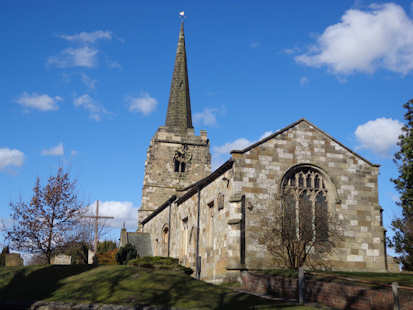
Historically, the parish comprised the township of Rillington and the chapelry of Scampston, within the Buckrose Wapentake of the East Riding of Yorkshire. Ecclesiastically, both fell under the Archdeaconry of the East Riding in the Diocese of York. The settlement appears in the Domesday Book as Redlinton(e) and Renliton, establishing its continuity from the late Saxon into the Norman period. At its centre stands St Andrew’s Church, of Norman origin, whose elevated position in the landscape hints at even earlier occupation.

Although long characterised as an agricultural community, Rillington underwent a marked period of transformation in the mid-nineteenth century. A key focus of this One-Place Study is the impact of the railway, particularly the arrival of the York and North Midland Railway in 1845. This is examined in detail through the 1844 Parliamentary Railway Plans and accompanying Book of Reference (held at the Parliamentary Archives), which identify landowners, occupiers, and the precise parcels of land acquired for the line. These sources allow the study to move beyond narrative into a spatial and social reconstruction of change at parish level.

The Rillington One-Place Study was established in 2004 and represents a long-term, source-driven reconstruction of the parish across time. It combines demographic analysis, landholding patterns, occupational structure, and micro-histories of families to explore continuity and change from the medieval period to the present day.

This work underpins my current research as an IHGS Licentiate candidate, where Rillington forms the basis of a detailed study into the relationship between transport infrastructure and societal change.

Sources and coverage:
The study draws on a wide evidential base, including:

  • 1086 Domesday Book
  • 1381 Poll Tax Assessments
  • 1640 First enclosure
  • 1672 Hearth Tax Returns
  • 1536-1837 Parish Registers (Baptisms, Marriages, Burials)
  • 1780 Enclosure Award
  • 1841-1911 Census Returns (fully transcribed and analysed)
  • 1844 Parliamentary Railway Plans and Book of Reference
  • 1848 Tithe Map and Apportionment Schedule
  • 1910 Valuation Office Survey
  • 1941-1943 National Farm Survey
  • Deeds and Manorial Records
  • Glebe Terriers and Ecclesiastical Records
  • Wills and Probate Material
  • Trade Directories and Newspaper Archives
  • Monumental Inscriptions
  • Historic Maps (including Ordnance Survey and footpath surveys)
  • Ephemera (billheads, signage, flags and related material)
  • Heraldic and genealogical collections

An extensive East Riding of Yorkshire reference library supports the study.

Archaeological Context

Evidence of earlier settlement includes an Iron Age barrow cemetery, reinforcing the long chronological depth of occupation within the parish landscape.

Research Context and Qualifications
This study forms the foundation of extensive academic work, including:

  • Higher Certificate in Genealogy – IHGS, Canterbury
  • Diploma in Genealogy – IHGS, Canterbury
  • Advanced Diploma in Local History – University of Oxford
  • Licentiateship – IHGS, Canterbury

Most assessed work across these qualifications has been rooted in Rillington, allowing for an unusually deep and sustained parish-level analysis.

Timeframe

The study covers the period from the Domesday survey of 1086 to the present, with a primary focus on c.1780-1861, when landscape and community change was most significant.

Population

1851: 951

Social Media Links

In-Depth Report

None specified

The Society for One-Place Studies is a leading organisation dedicated to supporting One-Placers worldwide.


Facebook Page  Instagram  YouTube  Members only Facebook Group  BlaySky Page

Contact Us

By email:
info@one-place-studies.org

By post:
Society for One-Place Studies,
7 Edge Lane,
Rossendale,
Lancashire
BB4 7SS
United Kingdom

© The Society for One-Place Studies